At the start of the 1920s, the California wine industry was still in its infancy.
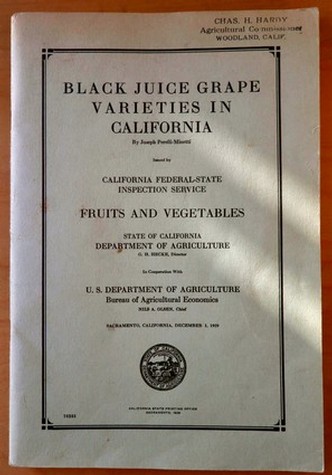
Yet a reading of a 1929 publication entitled Black Juice Grape Varieties In California—authored by Joseph Perelli-Minetti for USDA‘s State of California Department of Agriculture—provides a fascinating glimpse into how far the science of winegrowing had advanced since the 1850s, and how far it has come between the 1920s and today.
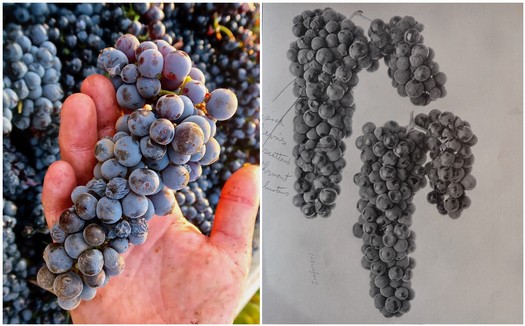
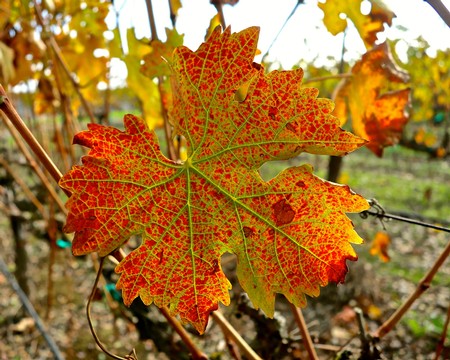
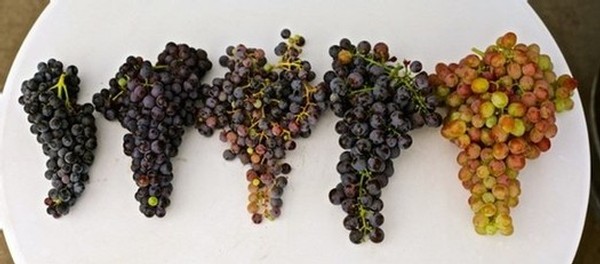
This 80-page book, consisting of highly detailed photographs and notes on leaf and cluster morphologies of 38 of the major black-skinned varieties cultivated during the 1920s, was loaned to me over the holidays by Tegan Passalacqua.
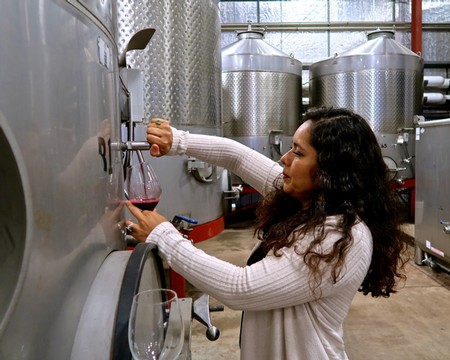
Passalacqua, the winemaker of both Turley Wine Cellars and his own Sandlands brand, is an avid (or, you can also say, obsessed) scholar of California wine history. It is an understatement to say that Passalacqua’s minimalist yet science-driven approach to viticulture and winemaking is strongly influenced by his respect for what has been historically done long before he was thought of.
The 1920s in itself is a fascinating era. While, on one hand, commercial wine production at that time was illegal (nationwide Prohibition lasting from 1920 to 1933), the U.S. Department of Agriculture still recognized wine grape farming as a major industry, demanding supportive research in order to stimulate further investment and market growth.
In fact, in regions such as San Joaquin County during the 1920s, both acreage and grape prices soared during the 1920s, primarily because of a loophole in the Volstead Act that allowed American households to produce up to 200 gallons a year of their own wine.
Historically, varieties of Vitis vinifera—i.e., cultivars belonging to the European family of wine grapes—were not brought in from East Coast nurseries until after California statehood, which happened on September 9, 1850. Before that, the only European grape cultivated in California was Mission (now also known as Criolla or Pais), planted along El Camino Real by Franciscan missionaries between 1769 and 1833.
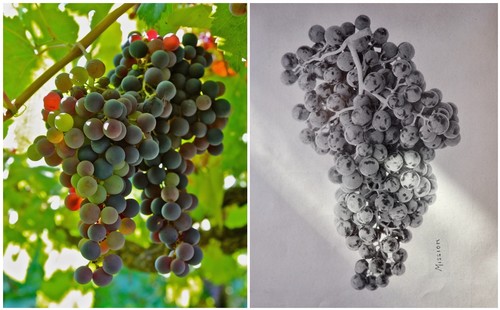
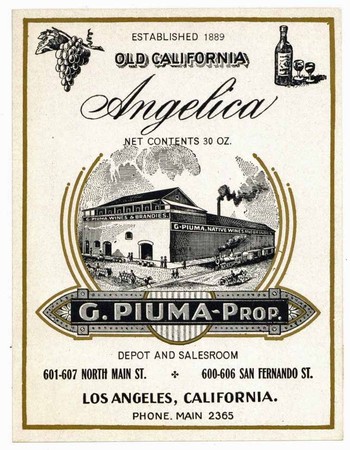
Wherever there were settlers of European descent, however, there was wine. Even during the 1930s, there were purportedly as many as two dozen commercial wineries operating in the Los Angeles area—their primary stock and trade, a strong, brandy-fortified “white” made from Mission known as Angelica (a sweet semi-generic style of wine still produced by a few handcraft wineries today).
Once settlers began pouring in from all over the world to the newly established state of California, enterprising growers in counties as far-flung as Sonoma, Napa, Santa Cruz, San Luis Obispo, Los Angeles, San Bernardino, San Joaquin, and Amador were shipping over dozens of grape varieties, and trying them all out in newly established vineyards.
In San Joaquin County, for instance, a Massachusetts transplant named George West established a nursery in Stockton in 1852. Along with a bevy of trees, fruits, and flowers, West immediately began to bring in grape varieties from Boston—his initial shipment, reportedly 40 different cultivars of European origin—on a yearly basis.
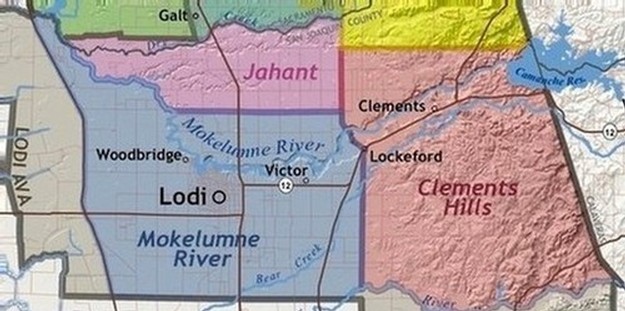
By 1857, Ezekial Lawrence, one of the City of Lodi‘s founding fathers, made note of the fact that there were at least 10 acres of grapes grown in the vicinity of the riverbank settlement. At that time this region, located just north of Stockton and south of Sacramento, was known by its indigenous California name, Mokelumne.
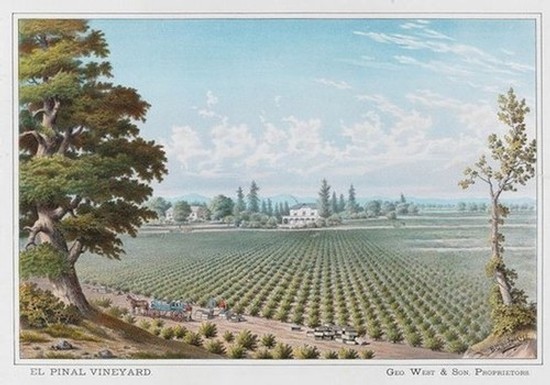
Recognizing the huge commercial potential of grapes for wine production, George West founded El Pinal Winery with his brother William in 1858, establishing their own vineyard in the Stockton area while also contracting farmers in Lodi to plant as many as 30 different grape varieties at a time. The initial idea, of course, was to throw as many of them as possible against the wall to see what sticks—a practice duplicated throughout the state.
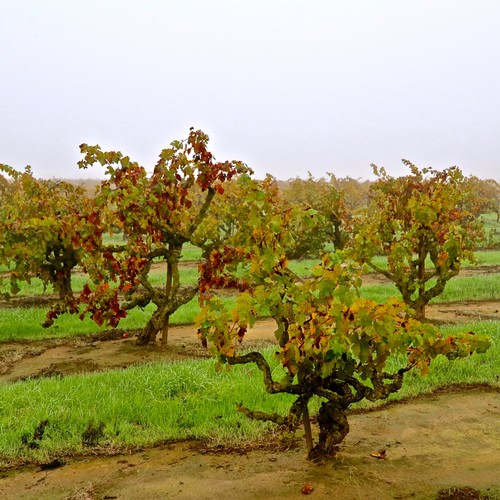
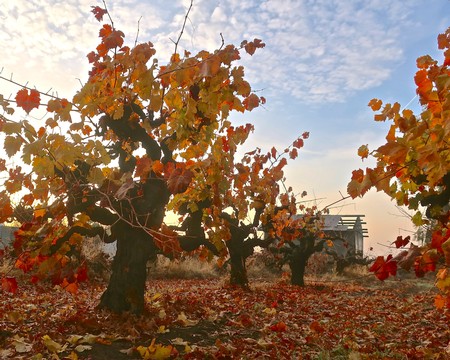
While the farming industry in the vicinity of the Mokelumne River was barely ten years old by the end of the 1850s, the area was already highly valued for its deep, rich soils—long evidenced by the watershed’s lush grasslands and deep-rooted valley oaks—and steadily warm yet moderate climate, highly conducive to multiple crops, from grains to grapes. To this day, Lodi remains a grape-dominated agricultural zone, whereas vineyards once dotting Los Angeles or nearby Sacramento and Stockton have all but disappeared.
Because Perelli-Minetti’s 1920s research in Black Juice Grape Varieties In California offers such interesting insights into the evolution of California’s wine industry, I think it is most useful to quote excerpts directly from the introduction, which was penned by W.F. Allewelt.
One of Allewelt’s first points is on the prevalence of mixed grape planting in vineyards, a common practice since the 1850s, resulting in the popularity of a wide range of generic blends such as “Burgundy” and “Claret,” consisting of any number and types of grapes:
Originally the older commercial wine grape plantings in California, particularly those in the northern coast districts of Sonoma, Mendocino, Napa, Solano, Contra Costa, and Santa Clara counties, very largely were of mixed varieties. This was partly due to a mixture of the cuttings as originally introduced from Europe, and distributed from the first plantings here; and partly intentional by planting mixtures of varieties desired for certain vintage blends.
Allewelt comments on the immediate impact of Prohibition on the make-up of plantings in vineyards, particularly with respect to varieties most suitable for long train rides to grape markets on the East Coast:
With the increase in production during recent years and the rapid development of eastern shipment, the question of variety has become one of major importance. Different varieties are adapted to particular and special uses, and some of the varieties formerly most desired for use in California are not, ordinarily, so desirable for eastern use on account of poor carrying qualities. These factors have brought about a marked differential in the values and prices paid for the different varieties…
One of the book’s more interesting observations is on the graphic impact of terroir, or differentiations of site conditions in California, which made differentiation of cluster morphology somewhat challenging:
The difficulty in identifying black wine grape varieties is due not only to the large number of varieties that are very similar in their characteristics but also to the fact that many of these varieties behave in widely different ways under different conditions. Soil texture, structure, composition, and moisture all have an important effect, as well as climatic conditions, which vary not only between districts but also between different seasons in the same district.
Many of the factors entering into the detailed descriptions of varieties in this work are more or less variable. Where this is the case the description is made of typical fruit most commonly occurring in those districts where the variety is properly adapted.
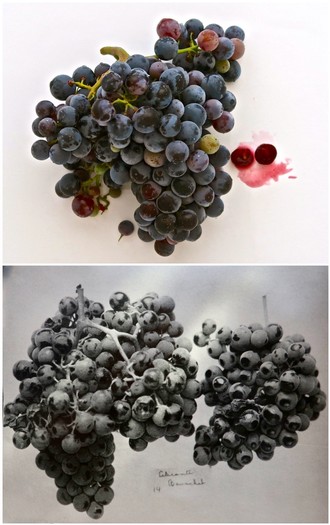
There is an interesting discussion of Alicante Bouschet, a teinturier (i.e., black juice variety) cultivar highly favored during Prohibition for its sturdiness useful for cross-country shipping:
While the color of the juice of the Alicante Bouschet is distinctly red, grapes of this variety from some districts in certain seasons have had very light flesh and juice, this being particularly true in the case of young vineyards in hotter districts…
In his discussion of variations of growing conditions in the different districts, Allewelt makes an interesting reference to Cornichon—nowadays, known as the extremely obscure French Vitis vinifera (also known as Purple Cornichon or Olivette Noire)—as well as Tokay (a.k.a., Flame Tokay), the latter once Lodi’s most widely planted grape (up until the 1970s):
The color of the grapes themselves is influenced by soil and climate, and the typical color described is that commonly found in localities where the variety is properly adapted. In this respect, however, there appears to be much less variation in the black wine varieties than in some others, particularly Tokay and Cornichon.
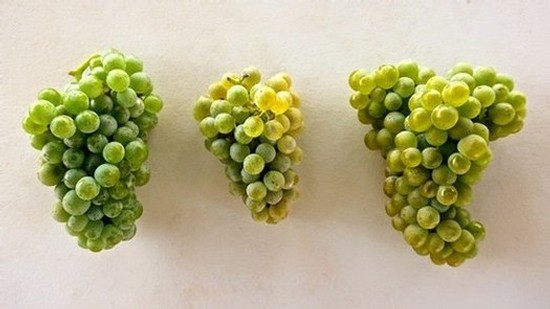
The size of bunches and berries shows some variation between districts, being generally smaller in non-irrigated districts than in those vineyards where irrigation is practiced. The fertility of soil, pruning methods, and volume of crop produced also influence the factor of [grape cluster] size. The form and density of bunches described are most commonly found in normal crops.
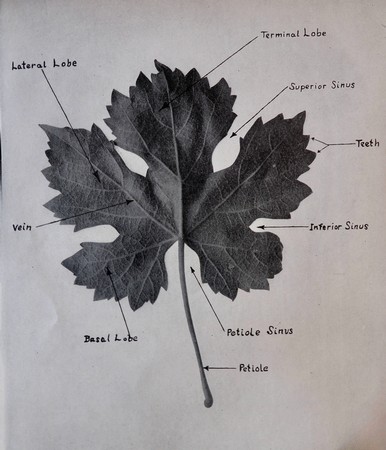
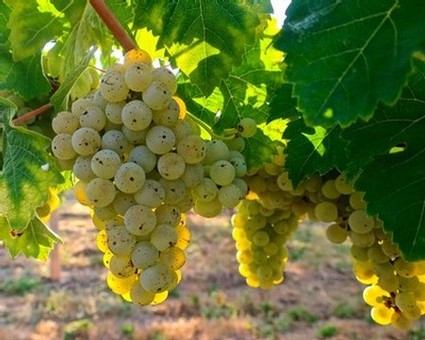
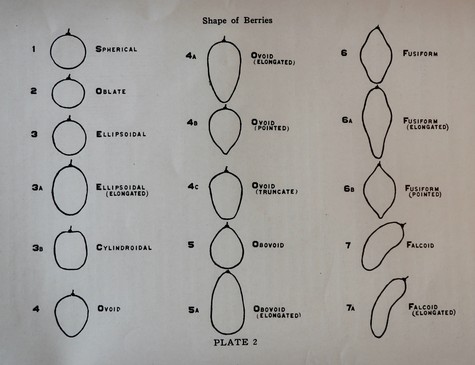
Despite the challenge of finding uniformity in grape morphology across districts cited in the book, Passalacqua sees this 1929 publication as a historical benchmark, saying, “These 1920s texts were the first wave of information helping to keep people in the California wine industry honest. By looking at the photos of grapes and leaves, a grape grower or winery could ascertain whether or not they were getting the grapes they were supposed to be getting.”
Although the 1929 book presages the era of varietal labeling on California wines by some 25, to 30 years, Passalacqua reminds us that not all pre-Prohibition bottlings were generic blends: “There were some varietal wines made, particularly with Zinfandel and Cabernet Sauvignon, even before the 1920s. This book was extremely useful because it allowed people to see the differences between grapes, offering a true ampelography [i.e., the science of grapevines], or guide, even if not all of the information available to the authors at the time was accurate.”
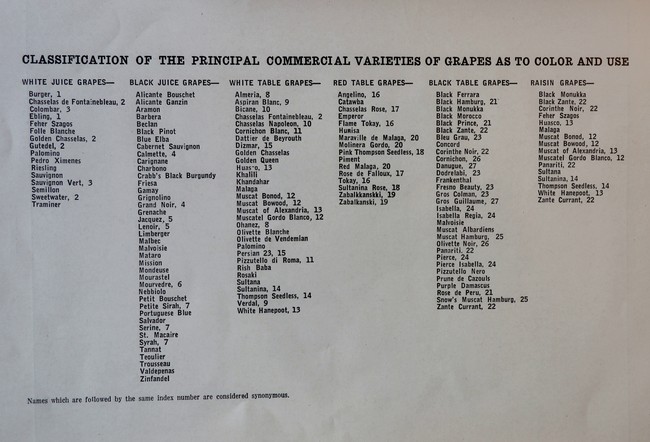
To give you an idea of the red wine grapes considered most important during the 1920s, here is the listing in this book:
Alicante Bouschet
Alicante Ganzin
Aramon
Barbera
Béclan
Black Pinot
Black Prince (also identified as Rose de Peru and classified primarily as a table rather than wine grape)
Blue Elba
Cabernet Sauvignon
Calmette (identified as synonymous with Grand noir)
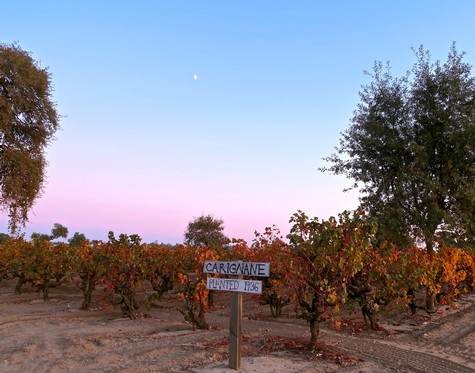
Carignane
Charbono
Crabb’s Black Burgundy (also identified as Refosco)
Friesa
Gamay
Grignolino
Grand noir (synonymous with Calmette)
Grenache
Jacquez (identified as synonymous with Lenoir)
Lenoir (synonymous with Jacquez)
Limberger
Malbec
Malvoisie
Mataró (listed separately from Mourvèdre, even though today we know it is the same grape)
Mission
Mondeuse
Mourastel
Mourvèdre (listed separately from Mataró)
Nebbiolo (synonymous with Spanna)
Petit Bouschet
Petite Sirah (identified as synonymous with Durif, Serine and Syrah)
Portuguese Blue
Salvador
Serine (synonymous with Durif, Petite Sirah, and Syrah)
St. Macaire
Syrah (synonymous with Durif, Petite Sirah, and Serine)
Tannat
Téoulier
Trousseau
Valdepeñas
Zinfandel
Some of my own remarks on a few of the grapes in this 1920s listing:
Black Pinot. According to UC Davis‘ Foundation Plant Services, Black Pinot is one of several nineteenth-century synonyms for the grape known far better today as Pinot Noir. Although known to have been cultivated in California as early as the 1880s, according to Foundation Plant Services’ essay on The Pinots, “the early history of Pinot noir was marked by confusion as to varietal identification… and lack of integrity in the production of wine produced in the [generic] name of ‘Burgundy’… the confusion would not be resolved completely until the 1970s.” Hence the fact that, at least in the 1920s, the California wine industry was pretty much oblivious to the charms of Pinot Noir, largely because the grape performs optimally in colder climate regions which weren’t even explored in California until the 1980s and after.
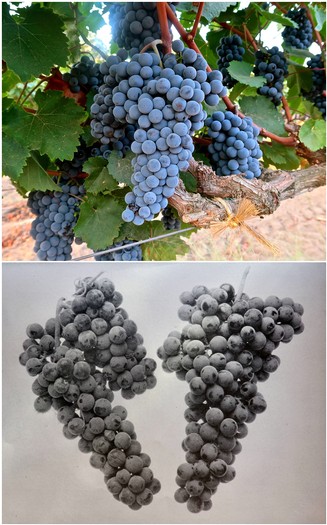
Charbono. Although once touted, up until the 1970s, as one of the state’s most prestigious grapes—particularly in Napa Valley—in 1999 UC Davis identified the correct name of Charbono as being Bonarda (as it is known in Argentina), which also makes it synonymous with the Douce noir of France’s Savoy region. It is still grown and bottled in California as Charbono.
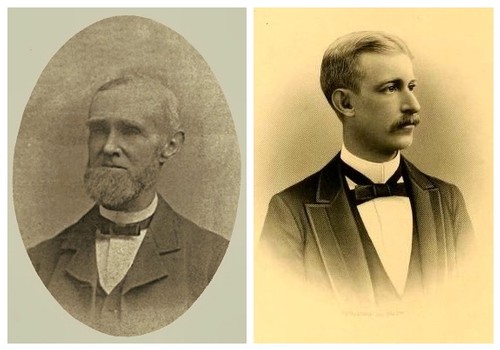
Two of California’s leading nineteenth century grape pioneers: Napa Valley’s Henry Walker Crabb (left), and George West (right, founder of Stockton’s El Pinal).
Crabb’s Black Burgundy. A somewhat fabled grape associated with Henry Walker Crabb, who between the 1860s and 1880s cultivated one of the largest collections of grape varieties in the state, in the vicinity of Oakville, Napa Valley (including the famed To-Kalon Vineyard). During the entire twentieth century Crabb’s Black Burgundy was considered to be synonymous with the Northern Italian grape Refosco, reputedly because of similarities in resulting wines—hence Perelli-Minetti’s citation. Recent DNA analysis has shown this not to be the case, and that the grape known as Crabb’s Black Burgundy was, in fact, a Savoie, France grape called Mondeuse noire, with no relation to Refosco.
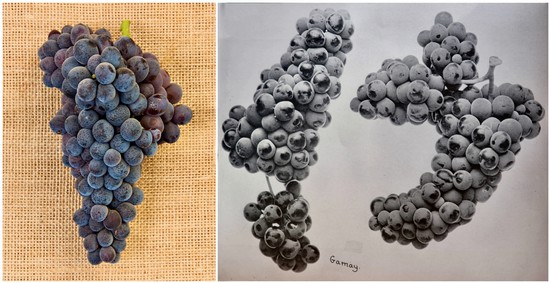
Gamay. Although Gamay noir is famous as the primary black grape of France’s Beaujolais region, up until 30 years ago almost all of the grapes planted as Gamay (a.k.a., Napa Gamay) in California vineyards were actually a variety called Valdiguié (the latter, originating in France’s Languedoc-Roussillon). The grape was not conclusively identified as such by UC Davis until 1980. Up until that time, there was also a variety bottled as Gamay Beaujolais, which turned out to be neither a true Gamay nor Valdiguié, but rather a clonal variant of Pinot noir. California wineries were allowed to bottle both misnomered varietals as “Gamay” up until 1999. True Gamay noir does exist in California but is far more popular as a varietal red in regions such as Willamette Valley and British Columbia.
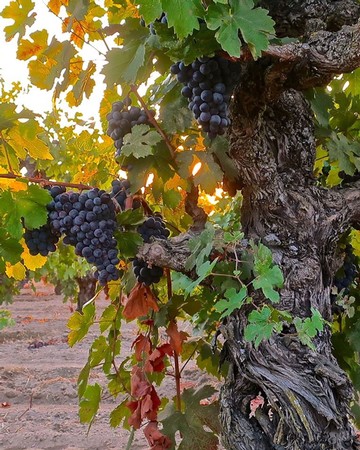
Malvoisie. Up until 2004, this grape was identified by UC Davis as Black Malvoisie; when, in fact, it is synonymous with the Southern French grape far better known and in higher demand than Cinsaut (a.k.a., Cinsault). Because of this simple matter of nomenclature, historic plantings such as Lodi’s Bechthold Vineyard (25 acres originally planted in 1886 as Malvoisie) became overnight sensations. Prior to 2004, no commercial winery wanted a black-skinned grape called Malvoisie. The redubbed grape went from virtual obscurity to fame, and Bechthold itself was named California State Fair’s “Vineyard of the Year” in 2014.
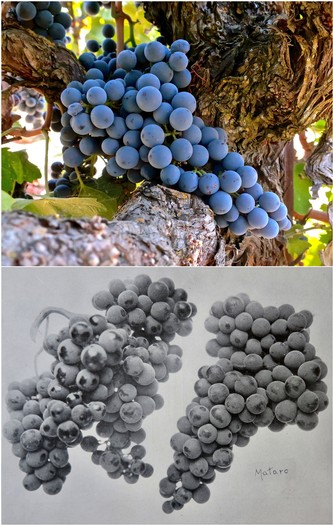
Mataró. For most of the twentieth century, Mourvèdre was cultivated as Mataró in California, although the two names are listed as if they were separate cultivars in Perelli-Minetti’s 1929 treatise. According to University of California researchers, both monikers, along with Monastell, originated in Spain, although the grape is called Mourvèdre in Southern France and Mataró was the parlance typically utilized by California’s Portuguese immigrants. By the start of the “Rhône Ranger” movement in California during the 1980s, it was widely understood that Mataró, Mourvèdre, and Monastrell were synonyms of the same grape.
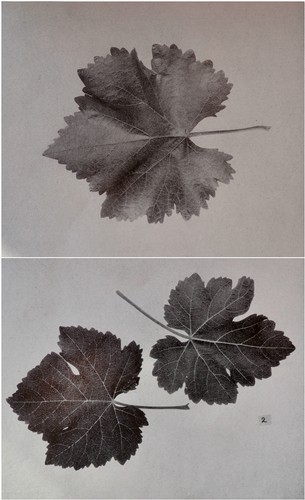
Mourastel. Although there are plenty of early 1900s references to the Mourastel grape cultivated in California, the only use of this name found in textbooks today is in reference to the South-West French grape called Fer, for which Petit Mourastel is an even more obscure synonym. It was not until recently, thanks to DNA analysis, that the identification of grape varieties has become more of an exact science. Up until then, the multitude of synonymous or similar names has often led to confusion, speculation, or errant assumption, even when misrepresentation is given in good faith. Just to give you one example, in the early 2000s a good number of California vineyards were planted to a grape called Monastrell, a well-known Spanish synonym for Mourvèdre (a.k.a., Mataró)—but not to be confused with the long discarded Mourastel, nor Moristel (the latter, a completely different Spanish grape). Although this particular selection of Monastrell was sourced from a reputable plant breeder in Portugal, it was found that the grape was neither a Monastrell nor any kind of variant of Mourvèdre, but in fact a Spanish grape called Graciano. Based upon descriptions in other early publications, Passalacqua believes that the “Mourastel” cited by Perelli-Minetti in the 1920s was, in fact, also a Graciano unbeknownst to the author. Foundation Plant Services originally released the misnomered Portuguese selection in 2007 as Monastrell. Following DNA testing, it was re-released in 2019 by its correct name, Graciano (FPS 08). Be as it may, growers who originally thought they had a clone of Mourvèdre (in commercial demand as a French “Rhône” grape) in their fields were suddenly forced to adjust to the fact that they have a Spanish grape—albeit one with plenty of its own positive attributes—on their hands. Since the late 1990s, as it were, Lodi’s Bokisch Vineyards has developed a sterling reputation for its varietal Graciano—in this case, a cultivar correctly identified in the field from the very beginning.
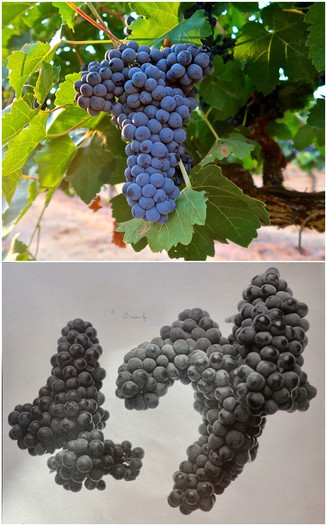
Petite Sirah. As recently as the mid-1990s, Petite Sirah was mistakenly believed in California to be a clonal variant of Syrah; in fact, even today the variety is bottled as Petite Syrah by some wineries. In 1997 UC Davis established, once and for all, that almost all the Petite Sirah grown in California is identical to the variety known in France as Durif, an 1860s crossing of Peloursin and Syrah grapes attributed to a Montpellier, France botanist named François Durif. It has been speculated that the Durif grape was introduced to California as early as 1884, and almost immediately became known as Petite Sirah, most likely because it was thought to be a Syrah, and also because it was often interplanted with actual Syrah (and sometimes with its co-parent, Peloursin).
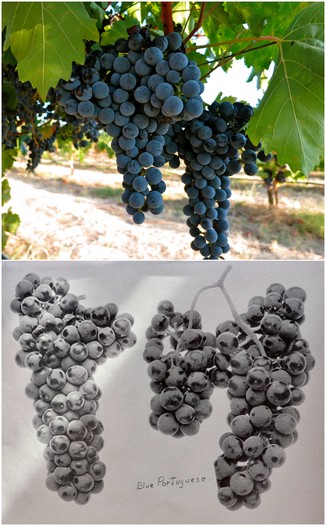
Portuguese Blue. Although this cannot be confirmed, based upon language alone (a dicey proposition when it comes to grape varieties), in all likelihood this is the same grape better known today as Blauer Portugieser—something of a misnomer in itself, since the grape of this name originated in either Hungary or Austria rather than in Portugal. Although the origin of its name is lost in time (probably in the 1700s), it has recently become more popular in Germany than anywhere else. While today it is almost unheard of in California, Blauer Portugieser is actually grown in Lodi’s Mokelume Glen Vineyards, along with over 50 other grapes of German or Austrian origin.
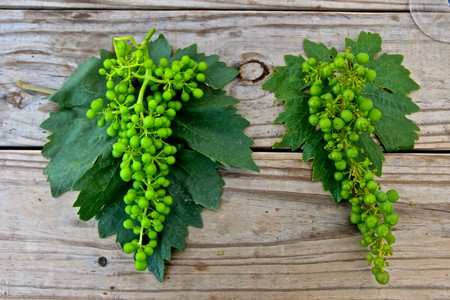
Valdepeñas. A grape far better known as Tempranillo, although listed by the USDA as Valdepeñas (a.k.a., Tinta Valdepeñas) for most of the twentieth century because clonal material of this grape disbursed throughout the state came from a University of California experimental station in the Foothills (in operation during the 1880s), which identified the selection as Valdepeñas rather than Tempranillo. It wasn’t until 2000 that Foundation Plant Services conclusively confirmed that the plant material long known in California as Valdepeñas is a selection of Tempranillo. Among Lodi-based wineries, Tempranillo has become arguably the most popular varietal red wine after Zinfandel, although most of the plant material cultivated here has come from more recent selections imported from Spain by growers such as Bokisch Vineyards.